Chimney caps · Sausalito

Chimney caps and spark arrestors in Sausalito

Is a cap even worth the cost, and how do I know which one my chimney needs?

Nothing to commit to — just call and we’ll line up a time that works.

  • Under an hour is typical for one flue, assuming the right model is already on hand.
  • A code-compliant, correctly sized spark-arrestor cap suited to the chimney type.
  • Roof access, plus the exact model on file if it’s a factory-built system.
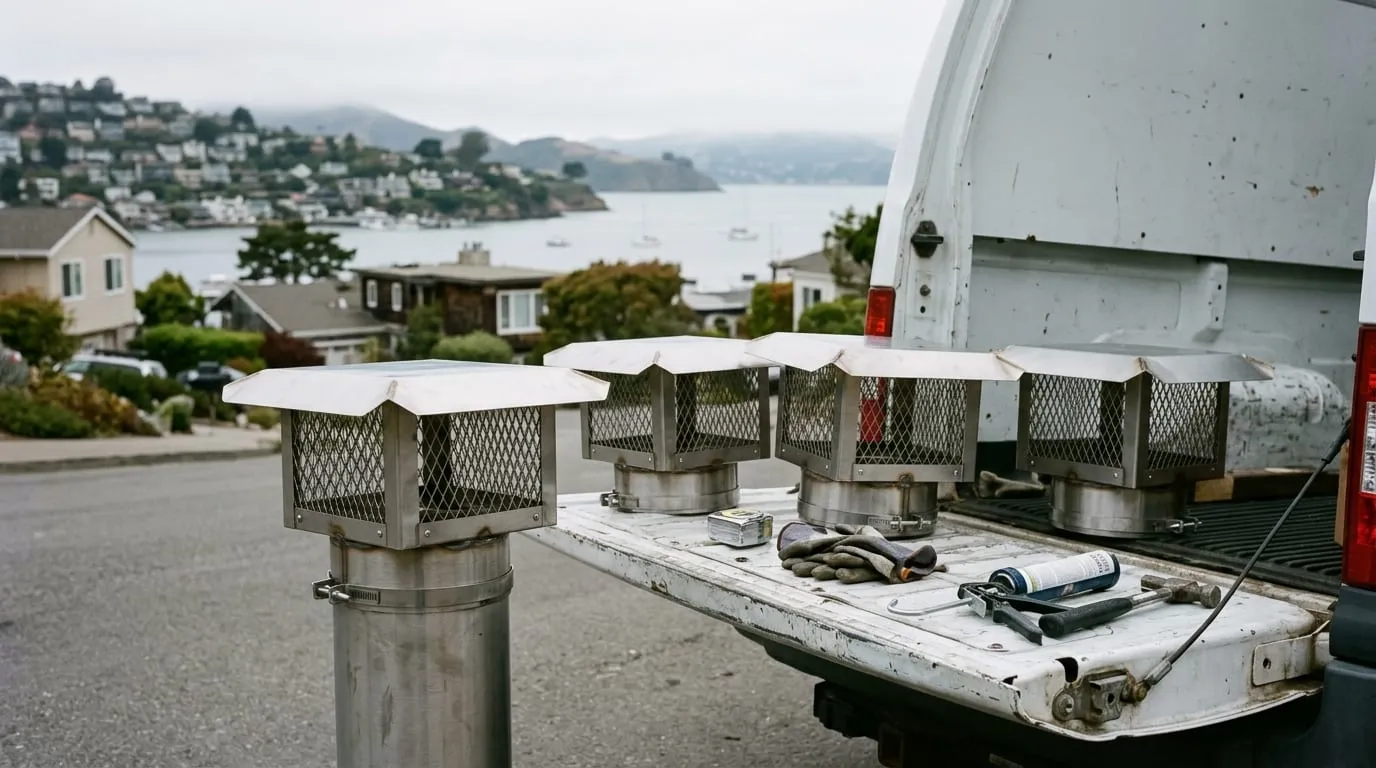
Several new stainless steel chimney caps with spark-arrestor mesh screens laid out on a work surface before installation in Sausalito

What a cap covers

The part at the very top

The cap and spark arrestor — traced against the same cutaway every service on this site uses.

The short answer

A cap’s job is keeping rain, marine-layer drip, redwood needles and birds looking for a nest out of the flue, while a spark arrestor built into it stops embers from an open fire from reaching a roof — a real requirement under California’s wildfire-era building code and Marin County’s Wildland-Urban Interface zones, not just a nice-to-have. What fits depends on what is already up there: a factory-built system needs the specific model listed for it to keep both the manufacturer’s rating and insurance coverage intact, while a masonry chimney generally accepts a properly sized universal cap as long as the mesh spacing meets spark-arrestor requirements. Nothing gets recommended before it gets measured, and a mismatched or missing cap ranks among the cheapest problems to fix now and the most expensive to leave alone.

Cutaway of a masonry chimney: the cap and spark arrestor at the top, then the crown, the flue liner running down inside the brickwork, the mortar joints, the flashing where the stack meets the roof, the smoke chamber, and the firebox down at the hearth.01020304050607
  1. 01Cap and spark arrestor Blocks salt spray off the harbor, drifting redwood needles and birds looking for a nesting spot from getting down the flue. Its mesh spacing is not a guess — California’s fire code and Marin County’s own Wildland-Urban Interface rules set the minimum.
  2. 02Crown The sloped cap at the very top of the stack. Down near the harbor the marine layer can blanket it for hours without a single drop of rain falling, and it is that lingering dampness — not storm totals — that starts the first hairline crack.
  3. 03Flue liner The channel that actually carries smoke out of the house. A gap or crack here is not cosmetic — it is a safety problem, since it lets heat and combustion gases reach material never meant to touch them.
  4. 04Mortar joints On an older stack, these joints are typically the first thing that gives way when the ground moves — and with the San Andreas Fault trace running through West Marin, that is a live local concern, not an imported one.
  5. 05Flashing Where the stack meets the roofline. On a hillside home in Sausalito or Tiburon, this joint has to turn water sideways off a steep pitch as much as send it downward, and a gap here is what usually shows up first as a slow stain creeping across a ceiling.
  6. 06Smoke chamber A ledge tucked just above the firebox that a straight brush pass never actually touches. In a harbor town where the air rarely stays dry for long, whatever collects on it tends to announce itself weeks later as a stale, smoky smell that will not go away.
  7. 07Firebox The one section of the whole chimney anyone actually looks at day to day — which is exactly why trouble building higher up the stack usually goes unnoticed until it finally shows itself down here.

Book this if you noticed

The usual signs

  • Nothing on the chimney at all, or a cap that’s visibly bent, rusted or gone.
  • Birds, leaves or redwood needles showing up repeatedly in the firebox or flue.
  • A universal cap that obviously doesn’t sit right on the flue opening.
  • Living in or near a Wildland-Urban Interface zone — Fairfax and the Mount Tamalpais foothills especially — without knowing if the setup is compliant.

Not sure your current cap meets code? Call (628) 296-4901 and walk us through what’s up there — we will sort out the right fix.

What is included

Cap installation, scoped plainly

Included

  • Measurement and system identification before recommending any cap
  • A cap matched to the chimney type, fitted with code-compliant spark-arrestor mesh
  • Removal and inspection of the crown or chase top underneath the old cap
  • Installation, sealing, and a final level-and-seat check

Not included

  • Crown repair or rebuilding, quoted separately if removal uncovers damage underneath
  • Full chase-pan replacement on a factory-built system, quoted as its own job when needed

Crown repair underneath the old cap is quoted separately if the removal reveals damage.

The visit

How a cap installation actually goes

  1. 1

    Measure and identify the system

    The flue opening gets measured and the chimney type — masonry or factory-built — gets confirmed before any cap gets suggested.

  2. 2

    Match the correct model

    A factory-built system receives the manufacturer’s own listed cap for that model; masonry gets a properly sized cap with mesh spacing that meets code.

  3. 3

    Remove and inspect the old cap

    Whatever cap is currently up there comes off, and the crown and flue opening underneath get checked while exposed.

  4. 4

    Install and seal

    The replacement cap goes on, gets sealed to the crown, and is secured to hold against wind.

  5. 5

    Final check

    A last check confirms the cap sits level, is properly seated, and is clear of debris before the job wraps up.

Several new stainless steel chimney caps with spark-arrestor mesh screens laid out on a work surface before installation in Sausalito

Cap and arrestor specifications

Caps and arrestors, by the numbers

What California’s fire code actually requires of a spark-arrestor cap — not a rough rule of thumb.

Net free area
At least 4× the flue’s net free area
Mesh opening size
3/8 in. to 1/2 in.
Corrosion resistance
19-gauge galvanized or 24-gauge stainless
Accessibility
Removable for flue cleaning, per code
Applies to
Every masonry and factory-built chimney with a fitted arrestor

California Building Code Chapter 7A and Marin County’s Wildland-Urban Interface fire-code adoptions covering spark-arrestor mesh.

In detail

Why the right cap depends on what is underneath it

Factory-built versus masonry, and why Marin’s own WUI zones raise the stakes.

01Two jobs, one fixture

People tend to think of a chimney cap as doing one thing, but it actually does two.

Continue reading

First is weatherproofing — keeping marine-layer drip, rain, and, across much of wooded Marin, falling redwood needles, bay laurel leaves and oak litter out of an open flue, since any of that debris can block airflow or add fuel to whatever creosote has already built up. Second, handled by the mesh spark-arrestor screen built into the same fixture, is fire protection — stopping embers thrown from an open wood fire before they can escape the flue and land on a roof or nearby dry brush. In California generally, and especially inside Marin’s own Wildland-Urban Interface zones around Mount Tamalpais, that second function is not negotiable — an open masonry fireplace or wood-stove chimney is required by fire code to carry spark-arrestor mesh, sized to the flue’s own net free area so embers stay blocked without choking off draft.

02The chimney underneath decides which cap fits

Chimneys do not all take the same cap, and mismatching the two is one of the most common — and costliest — errors that gets corrected here.

Continue reading

A factory-built, zero-clearance fireplace system was engineered and safety-listed as one complete unit, cap included, so bolting a generic universal or masonry-style cap onto it can void the manufacturer’s UL listing outright, and potentially the homeowner’s insurance coverage along with it. A traditional masonry chimney allows more flexibility, but it still needs a cap sized to its actual flue opening with mesh spacing that meets fire-code figures, rather than just whatever happened to be in stock. Measuring the flue and identifying the system comes first, every time, before any cap gets recommended.

03Marin’s tree canopy creates its own debris problem

Redwood, coast live oak and California bay laurel dominate the tree cover across much of central and western Marin, from the canyon streets of Mill Valley to the mountain-retreat neighborhoods around Fairfax.

Continue reading

Redwoods in particular drop fine needles almost year-round rather than in one autumn shed, and that steady debris works its way into an uncapped or poorly capped flue continuously rather than seasonally. Add marine-layer moisture on properties nearer the water, and the result is a denser, stickier buildup than dry leaf litter alone would ever produce. A properly fitted cap with correct mesh spacing keeps nearly all of it out — a bigger practical win here than it would be somewhere without this particular tree cover.

04Why cap material matters more near the water

Marine layer, and — closer still to the shoreline in Sausalito, Tiburon and Belvedere — direct salt spray off the bay both speed up corrosion on an exposed metal cap far faster than the same fixture would age in a drier inland town like Novato.

Continue reading

That is a big part of why stainless steel or heavier-gauge galvanized construction gets favored over the cheapest, thinnest cap options available — one that corrodes through in a few years rather than lasting a decade-plus turns out to be a false economy once a second installation visit’s labor gets factored back in.

05What can extend the job, and what stays fixed

A single accessible flue with a straightforward opening is the standard job — measure, match, pull the old cap, install and seal the new one, wrapped up in under an hour.

Continue reading

Multiple flues, an unusually tall or hard-to-reach chase on a steep hillside roof, or a crown that turns out to need work once the old cap comes off can all extend that timeline, and that gets flagged honestly before continuing rather than after. What never changes is the order things happen in: measure and identify the system first, recommend a cap only after.

06Booking a cap installation around Sausalito and Marin County

Whether a chimney has never had a cap at all, carries an old corroded or clearly wrong one, or simply needs confirmation that the current setup is fire-code compliant, this starts with a measurement and a straight answer about what is actually needed.

Continue reading

Coverage runs across a twenty-mile radius from central Sausalito.

Reviews

What the last 12 customers actually said

5.0

12 Google reviewscounted 2026-08-26

  • 512
  • 40
  • 30
  • 20
  • 10
  • Jillian Hodapp

    Heavy soot buildups around the chimney exit and the termination cap screen had to be swept away to stop persistent smoky backdrafts on windy nights.
  • Daniel Rodriguez

    Extensive soot discoloration on the fireplace brick ceased after a thorough cleaning that removed a significant draft blockage inside the smoke chamber corbels.
  • Angela Parker

    They had camera gear that allowed us to see the whole vertical flue way. It was good to see that our clay tiles had come throughout the severe winter without breaking.
  • david gabay

    Great service from start to finish! They were professional, on time, and left everything clean. Highly recommend for any chimney work.

Read all 12 reviews on Google

Questions

What people ask about caps

Is a spark arrestor legally required on a residential Marin County chimney?

Yes — in Wildland-Urban Interface areas such as Fairfax and the Mount Tamalpais foothills, and under the broader state fire code, an open masonry fireplace or wood-stove chimney needs a spark-arrestor mesh cap sized correctly, with net-free-area and mesh-opening figures measured rather than estimated.

Will any cap work on my factory-built fireplace?

No — a factory-built system requires the specific cap model listed for it. A universal or masonry-style cap fitted instead can void the manufacturer’s UL listing along with homeowner’s insurance coverage, and it is one of the most common mismatches corrected here.

Why does Marin’s tree debris matter for chimney caps specifically?

Redwood needles, bay laurel leaves and oak litter are everywhere across Mill Valley, Fairfax and the canyon towns, and unlike a single autumn leaf drop, that debris sheds nearly all year — it clogs an undersized or poorly sealed cap faster than it would somewhere without that canopy overhead.

How can I tell if my existing cap actually meets code?

The mesh opening and net free area get measured against current fire-code figures during the visit — a cap that looks perfectly fine from ground level can still have mesh that is too wide or too narrow to be compliant, especially in a stricter WUI zone.

My chimney has gone years without a cap — is installing one still worthwhile?

In almost every case, yes — an uncapped flue lets marine-layer moisture, debris and animals in continuously, and a cap costs far less than the crown, liner or nesting-related repair an uncapped chimney eventually ends up needing.

Book a cap installation

Tell us what is on the chimney now, if you know — we will confirm the right cap.

Or call (628) 296-4901 to book directly.

Tell us what changed.

Tell us what the fireplace is doing and what changed. Someone reads every message that comes in.

Nothing to commit to — just call and we’ll line up a time that works.

Prefer to talk? Call (628) 296-4901 — we’ll confirm when we can help.