
Chimney repair · Sausalito

Chimney repair in Sausalito

Does noticing one small crack really mean a huge, costly repair is coming?

Nothing to commit to — just call and we’ll line up a time that works.

  • A real inspection always precedes the written scope — never a driveway guess.
  • Timelines range from a single day of repointing up to a multi-day crown or liner job.
  • Nothing gets priced publicly ahead of time; the scope reflects actual condition, not a guess.
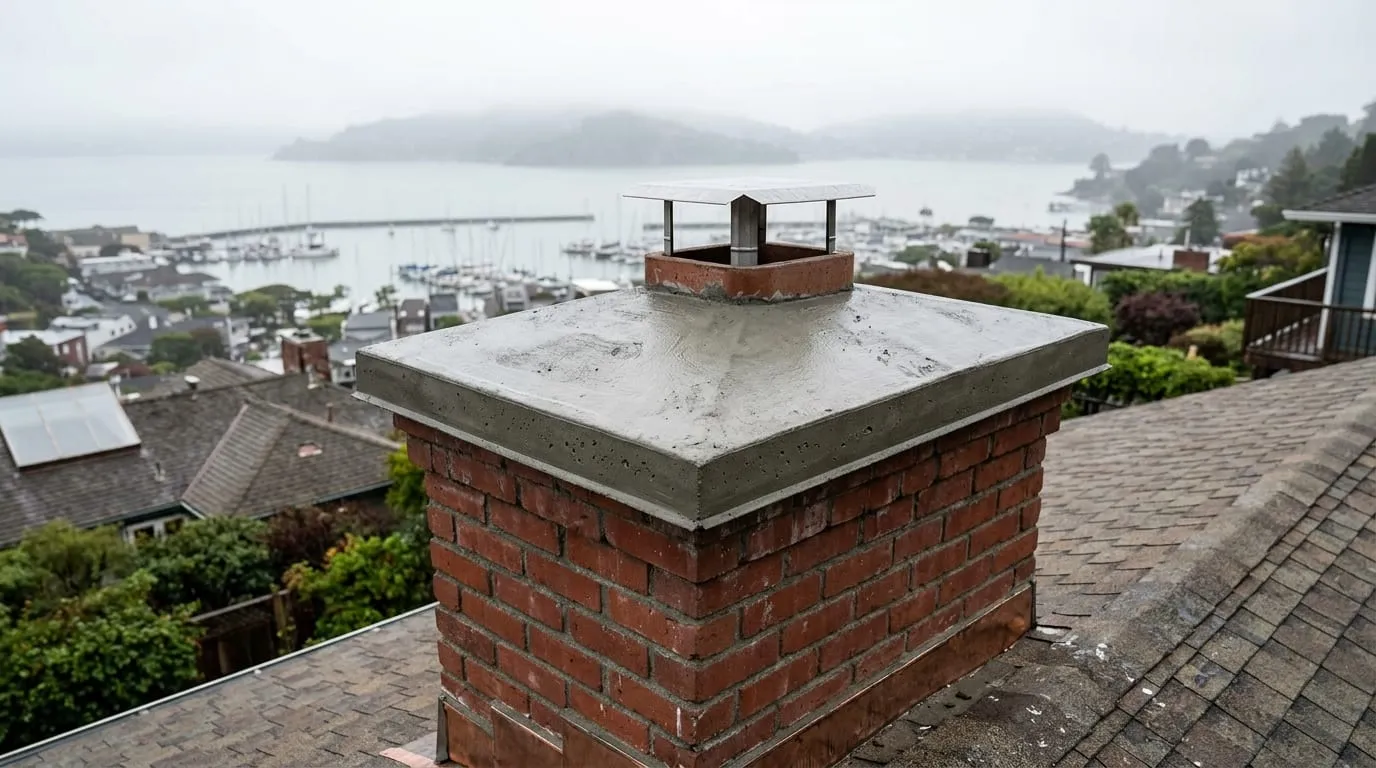
A freshly poured concrete chimney crown with a sloped surface and a drip edge, seen from a Sausalito hillside rooftop with the harbor and marine layer in the background

What repair covers

From a repointed joint to a full liner

Crown, mortar, flashing and liner — traced against the same cutaway every service on this site uses.

The short answer

Repair work spans a wide range — a modest mortar repointing job on one end, a full crown rebuild or liner replacement on the other — and how big any given job turns out to be comes down entirely to what an inspection finds, never to how old the house happens to be. Two things push repair calls here more than anywhere else in the area: the marine layer settling in daily and direct salt spray working into a cracked crown even without a drop of measurable rain, plus a real number of older hillside and canyon homes built long before modern seismic bracing was ever required. Every job starts with a diagnosis before a quote, the scope goes in writing, and a hairline crack never becomes an excuse to sell an unnecessary full rebuild — the reverse holds too, where a structural-tie problem does not get waved off as something a simple repointing job will fix.

Cutaway of a masonry chimney: the cap and spark arrestor at the top, then the crown, the flue liner running down inside the brickwork, the mortar joints, the flashing where the stack meets the roof, the smoke chamber, and the firebox down at the hearth.01020304050607
  1. 01Cap and spark arrestor Blocks salt spray off the harbor, drifting redwood needles and birds looking for a nesting spot from getting down the flue. Its mesh spacing is not a guess — California’s fire code and Marin County’s own Wildland-Urban Interface rules set the minimum.
  2. 02Crown The sloped cap at the very top of the stack. Down near the harbor the marine layer can blanket it for hours without a single drop of rain falling, and it is that lingering dampness — not storm totals — that starts the first hairline crack.
  3. 03Flue liner The channel that actually carries smoke out of the house. A gap or crack here is not cosmetic — it is a safety problem, since it lets heat and combustion gases reach material never meant to touch them.
  4. 04Mortar joints On an older stack, these joints are typically the first thing that gives way when the ground moves — and with the San Andreas Fault trace running through West Marin, that is a live local concern, not an imported one.
  5. 05Flashing Where the stack meets the roofline. On a hillside home in Sausalito or Tiburon, this joint has to turn water sideways off a steep pitch as much as send it downward, and a gap here is what usually shows up first as a slow stain creeping across a ceiling.
  6. 06Smoke chamber A ledge tucked just above the firebox that a straight brush pass never actually touches. In a harbor town where the air rarely stays dry for long, whatever collects on it tends to announce itself weeks later as a stale, smoky smell that will not go away.
  7. 07Firebox The one section of the whole chimney anyone actually looks at day to day — which is exactly why trouble building higher up the stack usually goes unnoticed until it finally shows itself down here.

Book this if you noticed

The usual signs

  • A crack visible across the crown, or discoloration on the brick just underneath it.
  • Mortar that has gone chalky, is crumbling, or is missing outright in spots.
  • A stain showing up on the ceiling or wall near the chimney after fog or rain.
  • A chimney that looks like it’s leaning, or has a new gap at the roofline.

Not sure whether it’s actually a repair situation? Call (628) 296-4901 and describe what you’re seeing — we will tell you plainly what it looks like.

What is included

Repair, scoped plainly

Included

  • A complete diagnostic inspection before any repair gets scoped
  • A written scope spelling out exactly what needs doing
  • Repointing, crown, flashing or liner work as the diagnosis calls for
  • A structural-tie check on any chimney built before 1960

Not included

  • A ground-up chimney rebuild, quoted and scheduled separately as its own larger project when damage genuinely warrants it
  • Structural engineering sign-off beyond the chimney itself, handled through a licensed engineer referral when a repair touches the building’s framing

A full rebuild is quoted and scheduled as its own larger project only if the diagnosis genuinely calls for it.

The visit

How a repair actually goes

  1. 1

    Full diagnostic inspection

    Crown, mortar, flashing and liner get checked in the sequence water and structural stress actually follow — not just wherever the symptom happened to show up.

  2. 2

    Written scope, before any work starts

    A plain, written description of what needs doing and why arrives first — no verbal-only estimate called out from the driveway.

  3. 3

    The repair itself

    Repointing, a crown rebuild, resealed flashing or liner work, scheduled to match whatever the property genuinely needs.

  4. 4

    Structural-tie check on older masonry

    On a chimney built before 1960, how it ties into the house framing gets confirmed during this same visit, not billed separately as an add-on.

  5. 5

    Final walkthrough

    A walkthrough covers what was done and what to keep an eye on, before the job gets called finished.

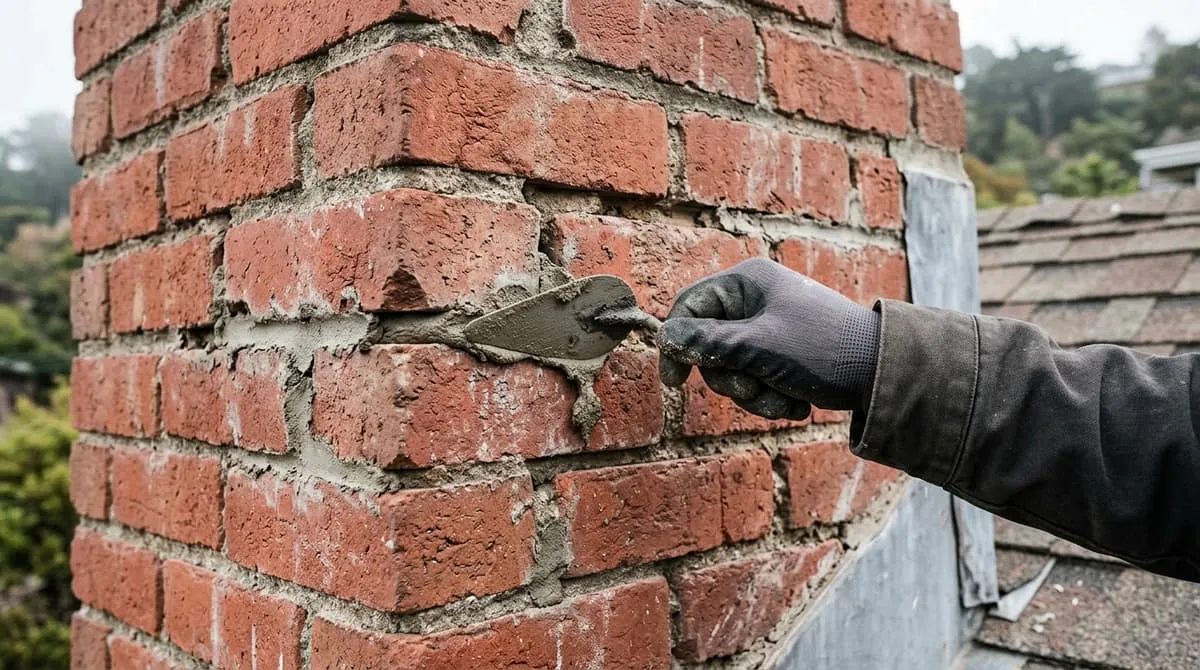
A mason repointing eroded mortar joints on a brick chimney of an older Sausalito hillside home

Repair specifications

Repair, by the numbers

What a repair scope gets measured against — condition drives it, never the house’s age by itself.

Crown
Sloped, crack-free, thrown clear of the brick
Mortar joints
Full, unweathered, no visible gaps
Flue liner
Continuous, no cracks or missing sections
Structural ties
Checked on any pre-1960s masonry chimney
Flashing
Fully lapped and sealed at the roofline

NFPA 211 condition criteria; Marin County and individual city building-department permit thresholds for structural work.

In detail

Why the marine layer and older masonry both drive repair calls

The mechanics of a cracked crown, and why diagnosis always comes before a quote.

01Diagnosis comes before anything else

The most common misstep in chimney repair is reacting to a symptom as though it were the entire story.

Continue reading

A ceiling stain near the chimney could trace back to a failed crown, a flashing failure, deteriorated mortar, or some mix of the three — and fixing only whatever happens to be visible from inside the house leaves the actual cause free to keep working on the masonry until it resurfaces later. Every job here begins with a full diagnostic pass, following the same path water and structural stress actually take: crown first, mortar joints next, then flashing, then the liner. Whatever that sequence turns up is what sets the scope — the scope never gets guessed first and diagnosed second.

02The marine layer does real damage, not just a passing climate detail

Rainfall figures alone miss the real driver of chimney moisture damage on a waterfront property in Sausalito or Tiburon.

Continue reading

The marine layer rolls in through the Golden Gate on a near-daily basis and sits on an exposed crown for hours, even on days a weather report would log as bone dry. A crown poured without proper slope, or one whose original seal has simply aged out, cracks the same way any crown eventually would — but the marine layer hands those cracks far more cumulative wet-hours than rainfall totals alone would suggest. That is the real reason a crown crack that might sit relatively stable for years in a drier town like Novato tends to worsen much faster on a hillside home sitting right above the harbor.

03A structural question rainfall never brings up

A meaningful portion of Marin’s older hillside and canyon housing stock — Sausalito’s Old Town, the Craftsman-era canyon streets of Mill Valley, Tiburon’s Main Street core — carries brick chimneys built well before any modern seismic bracing was ever required.

Continue reading

That masonry can be entirely sound in the ordinary sense, holding up fine against weather and age, while still lacking a proper tie into the house’s framing that would keep it from shifting or shearing during real ground motion. Because the San Andreas Fault trace runs through West Marin near Point Reyes and Bolinas, this is a genuine local factor rather than a borrowed worry. A repair visit on any chimney built before 1960 includes checking that structural connection directly — a question a purely cosmetic repair would never think to ask.

04Getting the repair to match how it was originally built

Repointing an older brick chimney takes more than packing fresh mortar into old joints.

Continue reading

Historic masonry, particularly anything predating the mid-1900s, was usually laid with a softer, more porous lime-based mortar than what gets used today. Repointing that older brick with a modern, harder Portland-cement mix can actually make things worse — the harder material does not flex or breathe the way the original mortar did, and it can push moisture out through the brick face itself instead of the joint, causing the brick to spall over time. Matching the original mortar type is a functional requirement of doing the repair correctly, not simply a look-and-feel choice.

05What grows the scope, and what stays constant

A single repointing job on one accessible section of chimney counts as a modest, contained repair.

Continue reading

A full crown rebuild, a liner replacement spanning the flue’s whole height, or work addressing a structural-tie deficiency on an older chimney is a considerably bigger undertaking — and which category a job falls into gets decided entirely by what the diagnostic inspection actually finds, never assumed from the chimney’s age or which particular Marin hillside it happens to sit on. What stays constant regardless is the order: diagnose fully, put the scope in writing, then do the work — and if the inspection turns up less than the symptom suggested, that gets said plainly too.

06Booking a repair around Sausalito and Marin County

Whether it is a crack, a stain, mortar that has clearly gotten worse, or simply wanting an older chimney’s structural condition confirmed, every job starts with a full inspection and a written scope before work begins.

Continue reading

Coverage runs across a twenty-mile radius from central Sausalito.

Reviews

What the last 12 customers actually said

5.0

12 Google reviewscounted 2026-08-26

  • 512
  • 40
  • 30
  • 20
  • 10
  • Jillian Hodapp

    Heavy soot buildups around the chimney exit and the termination cap screen had to be swept away to stop persistent smoky backdrafts on windy nights.
  • Daniel Rodriguez

    Extensive soot discoloration on the fireplace brick ceased after a thorough cleaning that removed a significant draft blockage inside the smoke chamber corbels.
  • Angela Parker

    They had camera gear that allowed us to see the whole vertical flue way. It was good to see that our clay tiles had come throughout the severe winter without breaking.
  • david gabay

    Great service from start to finish! They were professional, on time, and left everything clean. Highly recommend for any chimney work.

Read all 12 reviews on Google

Questions

What people ask about repair

Does a crack in the crown automatically mean a full rebuild?

Not necessarily — plenty of cracked crowns get fixed by resealing or recoating the existing slab. A full rebuild only gets recommended once the crown has actually failed structurally, and that distinction gets explained clearly before any quote.

Why is the marine layer such a factor in chimney repair here specifically?

Moisture off the bay settles onto a crown daily and works into a crack even on days with zero measurable rainfall, so a crack that might stay dormant longer in a drier inland town tends to worsen faster on a waterfront property in Sausalito or Tiburon — which is why the crown gets close attention on nearly every repair call near the water.

Is the mortar in an older hillside chimney different from what’s used today?

Frequently, yes — older lime-based mortar runs softer and more porous than what’s standard now, and that affects how repointing needs to be handled. Matching the original mortar type matters both for how it looks and for how well the repair actually holds up.

Does a repair visit check for earthquake damage?

It does — on any chimney built before 1960, the structural ties into the house framing get checked as part of the repair visit, since the San Andreas Fault trace runs through West Marin and that connection carries as much weight as the visible brickwork.

Would you say if a repair isn’t actually necessary?

Absolutely — when an inspection turns up a sound chimney and a symptom that’s minor or purely cosmetic, that gets said plainly. A repair that isn’t needed doesn’t get invented just to sell one.

Book a repair inspection

Tell us what you have noticed — we will diagnose it and put the scope in writing.

Or call (628) 296-4901 to book directly.

Tell us what changed.

Tell us what the fireplace is doing and what changed. Someone reads every message that comes in.

Nothing to commit to — just call and we’ll line up a time that works.

Prefer to talk? Call (628) 296-4901 — we’ll confirm when we can help.