Chimney sweep · Sausalito

Chimney sweep in Sausalito

Expecting a sweep to leave soot everywhere and end in an upsell? That is not how we run one.

Nothing to commit to — just call and we’ll line up a time that works.

  • Roughly an hour, start to finish, on a typical single-flue fireplace.
  • A cleared flue plus a written note covering whatever the inspection turned up.
  • Clear access to the firebox, and to the attic hatch if the property has one.
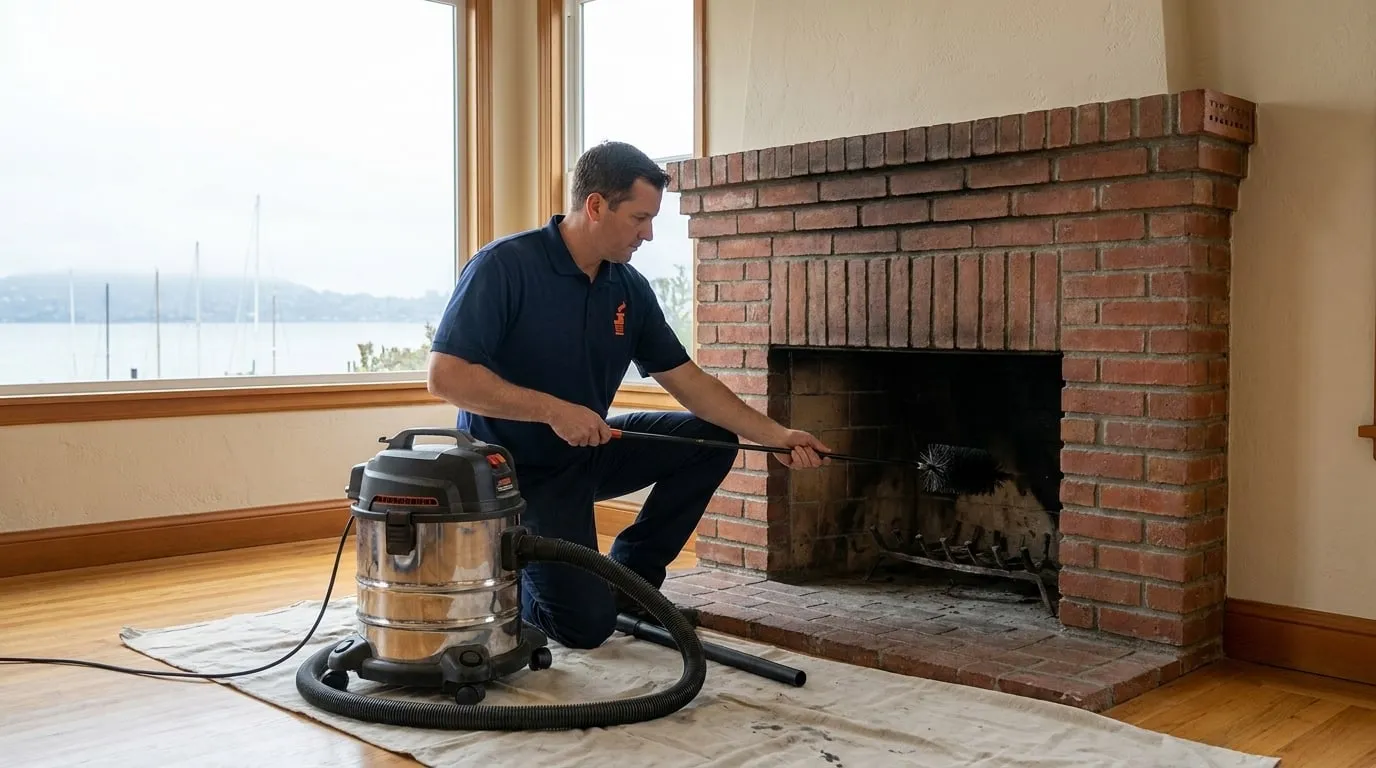
A technician kneeling at a brick firebox inside a Sausalito hillside home with the harbor visible through the window behind

What a sweep covers

Where the brush actually goes

The flue and the smoke chamber it feeds — traced against the same cutaway every service on this site uses.

The short answer

Once a year, a chimney sweep clears out the creosote and soot that has built up in the flue, using rotary or push-rod brushes matched to the liner size, and wraps up with a Level 1 inspection covering everything reachable without a camera or a ladder. Around Sausalito and the rest of Marin, fireplaces and wood stoves tend to sit idle for stretches through a season that is mild but rarely dry, and that stop-and-start pattern hides how much creosote has actually accumulated — often more than an owner would guess. Sweeping annually is what keeps that buildup below the point where it could ignite, and the same visit is when a technician is most likely to spot a cracked crown, mortar worn down by the marine layer, or a cap that has come loose, before any of it grows into a repair job. Floor and hearth stay protected the whole time, the brush travels the full length of the liner, and the firebox and smoke shelf get vacuumed clean before anyone leaves.

Cutaway of a masonry chimney: the cap and spark arrestor at the top, then the crown, the flue liner running down inside the brickwork, the mortar joints, the flashing where the stack meets the roof, the smoke chamber, and the firebox down at the hearth.01020304050607
  1. 01Cap and spark arrestor Blocks salt spray off the harbor, drifting redwood needles and birds looking for a nesting spot from getting down the flue. Its mesh spacing is not a guess — California’s fire code and Marin County’s own Wildland-Urban Interface rules set the minimum.
  2. 02Crown The sloped cap at the very top of the stack. Down near the harbor the marine layer can blanket it for hours without a single drop of rain falling, and it is that lingering dampness — not storm totals — that starts the first hairline crack.
  3. 03Flue liner The channel that actually carries smoke out of the house. A gap or crack here is not cosmetic — it is a safety problem, since it lets heat and combustion gases reach material never meant to touch them.
  4. 04Mortar joints On an older stack, these joints are typically the first thing that gives way when the ground moves — and with the San Andreas Fault trace running through West Marin, that is a live local concern, not an imported one.
  5. 05Flashing Where the stack meets the roofline. On a hillside home in Sausalito or Tiburon, this joint has to turn water sideways off a steep pitch as much as send it downward, and a gap here is what usually shows up first as a slow stain creeping across a ceiling.
  6. 06Smoke chamber A ledge tucked just above the firebox that a straight brush pass never actually touches. In a harbor town where the air rarely stays dry for long, whatever collects on it tends to announce itself weeks later as a stale, smoky smell that will not go away.
  7. 07Firebox The one section of the whole chimney anyone actually looks at day to day — which is exactly why trouble building higher up the stack usually goes unnoticed until it finally shows itself down here.

Book this if you noticed

The usual signs

  • A campfire-like smell that hangs around the room after the fire has died down.
  • Black flakes or soot turning up in the firebox on their own.
  • It has been over a year, or the last sweep date is a mystery.
  • Smoke drifting back into the living space instead of pulling up the flue.

Not sure a sweep is really what’s called for? Call (628) 296-4901 and tell us what’s going on — we will steer you toward the right visit.

What is included

The sweep, scoped plainly

Included

  • One full brush pass covering the entire length of the flue liner
  • Sealed vacuum extraction to clear loosened creosote and soot
  • A Level 1 inspection under NFPA 211 of every accessible component
  • Floor and hearth protection kept in place for the whole visit
  • A written note describing anything found before we leave

Not included

  • Camera work inside concealed sections, which falls under a separately booked Level 2 inspection
  • Any masonry repair, crown work or cap swap the sweep uncovers, quoted as its own separate job

Camera work and any repair get scoped and priced as their own separate jobs — a sweep visit stays a sweep visit, with nothing sprung on you afterward.

The visit

How a sweep actually goes

  1. 1

    Floor and hearth protection

    Everything goes down first — drop cloths from the firebox opening out along the whole path anyone will walk carrying gear.

  2. 2

    Brush the flue

    A brush matched to your liner’s diameter travels the whole run top to bottom, knocking loose the creosote and soot clinging to the walls.

  3. 3

    Sealed vacuum extraction

    A HEPA vacuum stays sealed against the firebox opening for the entire pass, catching debris before it ever gets a chance to settle in the room.

  4. 4

    Level 1 inspection

    A visual pass over every reachable inch of flue, firebox and connection point, checking for cracks, gaps or wear.

  5. 5

    Written notes

    Whatever turns up during the inspection, however small, gets written down before we leave — no on-the-spot pressure to book anything.

A technician kneeling at a brick firebox inside a Sausalito hillside home with the harbor visible through the window behind

Sweep specifications

Sweep, by the numbers

These figures come straight from the inspection standard the whole industry works from — not a number we picked ourselves.

Inspection standard
NFPA 211, Level 1
Recommended frequency
Annually, with regular use
What gets brushed
Full length of the flue liner
Debris handling
Sealed vacuum extraction, floor protected
Typical visit length
45–75 minutes

NFPA 211: Standard for Chimneys, Fireplaces, Vents, and Solid Fuel-Burning Appliances.

In detail

What a sweep clears, and why it matters

The mechanics of creosote buildup, and why an annual pass is the single most effective thing an owner can do.

01What actually builds up inside a flue

Smoke leaves behind creosote as it cools on its way up — a tar-like coating that sticks to the inside walls of the liner.

Continue reading

A thin layer is nothing to worry about. What is a concern is what a season or two of occasional fires can leave behind: enough of that residue sitting inside the chimney to reach a temperature at which it can catch on its own. Sweeping is the mechanical fix — a brush cut to match the liner’s diameter travels its full length, top to bottom, breaking that buildup free so it can be pulled out with a vacuum instead of sitting there accumulating visit after visit.

Because Marin’s climate stays mild, plenty of local fireplaces get used in bursts through the cooler months rather than burned nightly the way a wood stove elsewhere might be, and that stop-start pattern makes it easy to lose track of how long it has actually been since the last sweep. Creosote does not care whether the fires were daily or occasional — given enough time either way, it reaches a dangerous level, and an annual check is really the only way to know for certain where a given flue stands.

02Keeping the mess contained

What people worry about most is rarely the work itself — it is the soot.

Continue reading

Brushing loose creosote inside a tight flue means that debris has to go somewhere, and left unmanaged it would land on the hearth, the rug, and everything nearby. That is not how this goes. Protection covers the hearth and the path to it before the first brush stroke, and a HEPA vacuum stays sealed to the firebox opening for the entire pass, drawing debris out as it falls instead of letting it settle anywhere in the room. Whatever the space looked like when the appointment started is how it looks when the crew leaves.

03Why an inspection rides along with every sweep

Clearing a flue tells you it is clear. It does not, on its own, tell you it is safe — that is the job of the Level 1 inspection that comes bundled with every sweep.

Continue reading

NFPA 211 spells out what that covers: everything a technician can see and reach without a camera or a trip onto the roof, meaning the accessible interior of the flue, the firebox, the smoke chamber right above it, and the point where the appliance connects to the chimney. For a chimney in continued, ordinary use with nothing recently changed and no reason to suspect hidden trouble, that depth of check is exactly right.

Where the visual check turns up something a trained eye cannot fully account for — a crack that could run deeper than it appears, or damage traced back to an earthquake or a rough winter storm — that gets flagged plainly, with a Level 2 camera inspection recommended next, rather than guessing at what a flashlight alone cannot show.

04What can stretch the visit, and what never does

A single flue with straightforward access is the baseline: about an hour, one technician, protection down for the entire visit.

Continue reading

A second flue, a wood stove’s own connector pipe, steep roof access at a hillside home in Sausalito or Tiburon, or a floating home out at Waldo Point Harbor can all add time, and that gets flagged before work begins if the job looks bigger than the baseline. What stays fixed regardless is the order things happen in — protect, brush, extract, inspect, report — no matter how many flues are involved or how long it has been since the last visit.

05Booking a sweep in Sausalito and Marin County

We work across a twenty-mile radius from central Sausalito. Let us know the last service date if you have it, any smell, smoke or debris you have noticed, and whether the property sits on a hillside or floats at a dock — knowing that ahead of time means we show up ready for the actual job instead of figuring it out once we are already on the ladder.

Reviews

What the last 12 customers actually said

5.0

12 Google reviewscounted 2026-08-26

  • 512
  • 40
  • 30
  • 20
  • 10
  • Jillian Hodapp

    Heavy soot buildups around the chimney exit and the termination cap screen had to be swept away to stop persistent smoky backdrafts on windy nights.
  • Daniel Rodriguez

    Extensive soot discoloration on the fireplace brick ceased after a thorough cleaning that removed a significant draft blockage inside the smoke chamber corbels.
  • Angela Parker

    They had camera gear that allowed us to see the whole vertical flue way. It was good to see that our clay tiles had come throughout the severe winter without breaking.
  • david gabay

    Great service from start to finish! They were professional, on time, and left everything clean. Highly recommend for any chimney work.

Read all 12 reviews on Google

Questions

What people ask about a sweep

How often does a fireplace around Sausalito or Marin actually need a sweep?

Once a year under regular use is what NFPA 211 recommends — a daily-burned wood stove may need it sooner, while a fireplace lit only a handful of times all season, common in this region’s milder climate, can often stretch that interval.

Is my living room going to end up covered in soot?

It should not — a vacuum stays sealed to the firebox opening for the entire brushing pass, and drop cloths go down before anything starts, so loosened debris has nowhere to land but the vacuum.

Do gas fireplaces get swept the same way?

Not quite — a gas unit calls for a different service centered on the venting and burner rather than clearing creosote, so let us know which type you have when booking.

If the technician finds something wrong during the sweep, what happens?

It gets written down and explained plainly on the spot. Nothing gets repaired that same visit unless you say go ahead, and there is zero pressure to schedule anything right away.

Does a sweep already cover what an inspection would?

It covers a Level 1 inspection — everything visible without a camera. A deeper Level 2 camera inspection is booked as its own separate service; our chimney inspection page has the details.

Book a sweep

Tell us the last time it was serviced, if you know — we will confirm the right visit.

Or call (628) 296-4901 to book directly.

Tell us what changed.

Tell us what the fireplace is doing and what changed. Someone reads every message that comes in.

Nothing to commit to — just call and we’ll line up a time that works.

Prefer to talk? Call (628) 296-4901 — we’ll confirm when we can help.