Wildfire and WUI spark-arrestor rules in Marin County
Fairfax, Mill Valley’s canyon streets and parts of Novato sit inside a genuine Wildland-Urban Interface zone under California fire code. Here is what a WUI designation actually changes about a chimney cap, and how to tell if your property is inside one.
Published
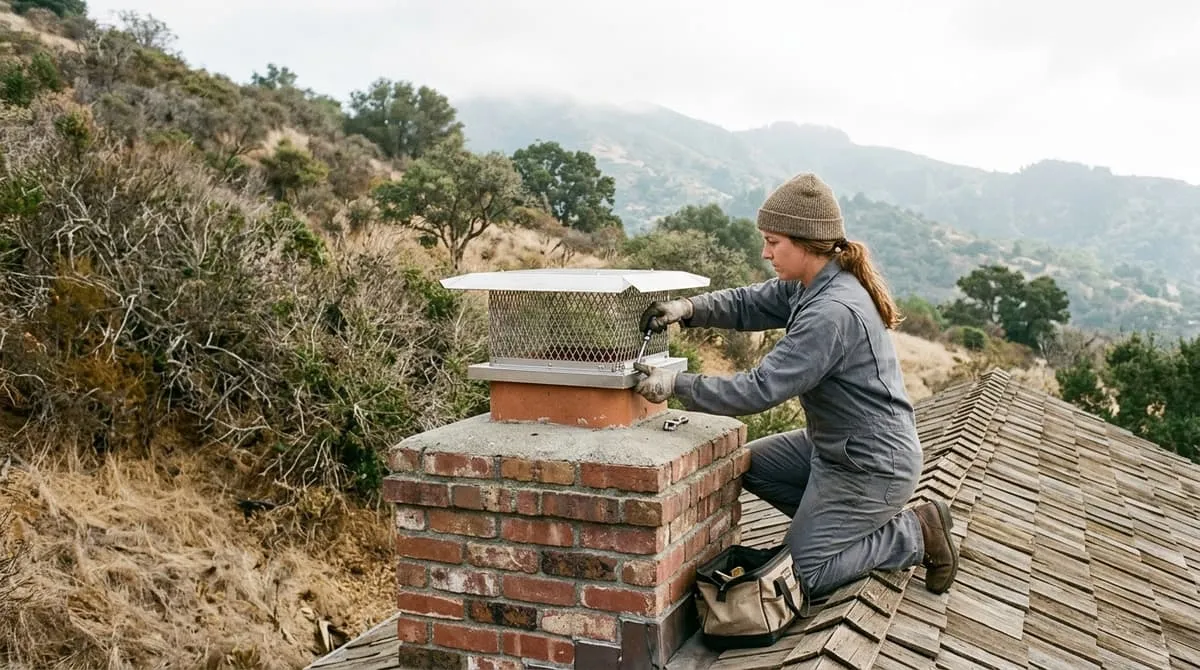
Wildland-Urban Interface, usually shortened to WUI, is a specific designation under California’s fire code — not a vague description of “near some trees.” It marks the zone where developed property sits close enough to wildland vegetation that a wildfire can move directly between the two, and Marin County has a genuine, mapped share of it, concentrated around Mount Tamalpais and its foothill communities. Understanding what that designation actually changes about a chimney is worth doing before a spark-arrestor cap gets treated as an afterthought.
What WUI actually designates
A WUI zone is not simply “anywhere with trees nearby.” It is a mapped classification based on the density and continuity of wildland vegetation directly adjacent to developed parcels, assessed and adopted at the state and local level under California’s fire code. A property can sit surrounded by individual trees and still fall outside a formally designated WUI zone if the surrounding vegetation does not meet the continuity threshold that actually drives fire spread. Conversely, a property that looks unremarkable from the street can sit squarely inside one if it backs onto open wildland that connects, uninterrupted, to a larger fuel bed further out. The designation is about fire behavior, not appearance.
Where Marin’s WUI zones concentrate
Fairfax sits pressed directly against the western slopes of Mount Tamalpais and the Marin Municipal Water District watershed, which makes it the clearest WUI case among the communities in our service area — much of the town backs onto continuous open wildland with no buffer in between. Mill Valley’s canyon streets, climbing directly up toward Mount Tamalpais State Park, carry a similar designation for the same underlying reason. Novato’s northern and eastern edges, where development meets open grassland and oak woodland, add a third, somewhat different pattern — grassland fire behaves differently than forested canyon fire, but the WUI logic that governs cap requirements is the same either way.
What the designation changes about a spark-arrestor cap
Outside a WUI zone, California’s general fire code still requires spark-arrestor mesh on an open masonry fireplace or wood-stove chimney, sized to specific net-free-area and mesh-opening figures. Inside a WUI zone, the same underlying mesh-spacing principle applies, but the margin for error shrinks — an undersized or corroded arrestor that might go unnoticed on a property with no adjacent wildland becomes a genuinely higher-consequence oversight on a property where an escaped ember has continuous fuel to travel through. We check every Marin cap against the current code regardless of location, but a WUI property gets that check treated as a genuine priority rather than a routine formality.
How to tell if your property is inside a WUI zone
The most reliable way to confirm WUI status for a specific address is Marin County’s own fire-hazard-severity mapping, maintained alongside the state’s own CAL FIRE zone designations — a homeowner can look up a specific parcel rather than relying on a general sense of the neighborhood. In practice, though, a rough rule holds for most of our service area: a property backing directly onto open wildland, undeveloped hillside, or continuous tree canopy with no meaningful buffer — much of Fairfax, the upper reaches of Mill Valley’s canyons, and Novato’s grassland-adjacent edges — is worth checking specifically, even if the exact boundary line requires the county’s map to confirm.
Older homes and caps installed before the current code existed
A meaningful number of Marin’s mountain-adjacent homes, particularly Fairfax’s early-1900s mountain-retreat-era stock, predate any spark-arrestor requirement entirely. A chimney cap installed decades ago, even one that looks intact from the ground, may carry mesh spacing that was never held to today’s standard because that standard did not exist when it went up. Age alone is not the test — a cap installed even ten or fifteen years ago may already fall short of the current WUI-specific requirements if the property’s designation has changed or the mesh has simply corroded past its original spacing.
What this means beyond the cap itself
A compliant spark arrestor is the single most direct, most affordable step a WUI-zone homeowner can take on the chimney itself, but it works alongside broader defensible-space requirements — vegetation clearance around the structure, roof material, ember-resistant vents — that fall outside chimney work specifically. We focus on what we actually do: confirming the cap and mesh meet current code, and flagging clearly if what we find does not, rather than offering opinions on defensible-space landscaping that belongs to a different trade entirely.
Insurance carriers are paying closer attention too
Beyond the fire-code requirement itself, a growing number of homeowner’s insurance carriers writing policies in California’s WUI zones now ask specifically about spark-arrestor compliance as part of wildfire-risk underwriting, alongside defensible-space clearance and roof material. A homeowner renewing coverage on a Fairfax or upper Mill Valley property may be asked directly whether the chimney has a compliant cap, and being able to answer with a confirmed, current inspection rather than a guess can matter for the renewal itself, not only for fire safety. We are not an insurance advisor and do not speak to a specific carrier’s underwriting criteria, but we can document what we find in writing, which is the kind of record a carrier’s request usually wants.
What happens during a WUI inspection, specifically
A cap check in a designated WUI zone follows the same physical steps as anywhere else — measuring the flue opening, checking the existing mesh spacing and net free area, inspecting for corrosion — but we hold the result to the WUI-specific threshold rather than the general fire-code minimum, and we say so plainly if a cap that would pass outside a WUI zone does not meet the stricter local standard. That distinction is easy to miss without local knowledge of exactly where Marin’s zone boundaries fall, which is part of why a countywide chimney company that knows the specific towns matters more here than it might in a flatter, more uniform service area.
Booking a cap check in a Marin WUI zone
If your property sits in or near Fairfax, Mill Valley’s canyon streets, or Novato’s grassland-adjacent edges, and you are not sure your current cap meets today’s spark-arrestor requirements, we measure the mesh and net free area against the current standard during the visit — not a guess from the ground. We work across a twenty-mile radius from central Sausalito, WUI zones included.
Read next
More from the blog
When chimney work in Marin County needs a permit
A chimney repair that needs a permit in San Rafael may route through a completely different office than the same repair in Fairfax or unincorporated Marin. Here is what typically triggers a permit, and who to ask.
How Mount Tamalpais' terrain affects chimney draft
Two nearly identical fireplaces a few streets apart in Mill Valley or Fairfax can draw completely differently, and the reason usually has more to do with the mountain looming over both of them than with either chimney itself.
Chimney work on Sausalito’s hillside homes
A Sausalito hillside address is not a driveway job. Narrow switchback stairs, steep roof pitches and terraced lots change how equipment reaches the roof and how long a visit actually takes — here is what that means before you book.
Book a WUI cap check
Tell us your address — we will confirm what the current code requires there.