How Mount Tamalpais' terrain affects chimney draft
Two nearly identical fireplaces a few streets apart in Mill Valley or Fairfax can draw completely differently, and the reason usually has more to do with the mountain looming over both of them than with either chimney itself.
Published
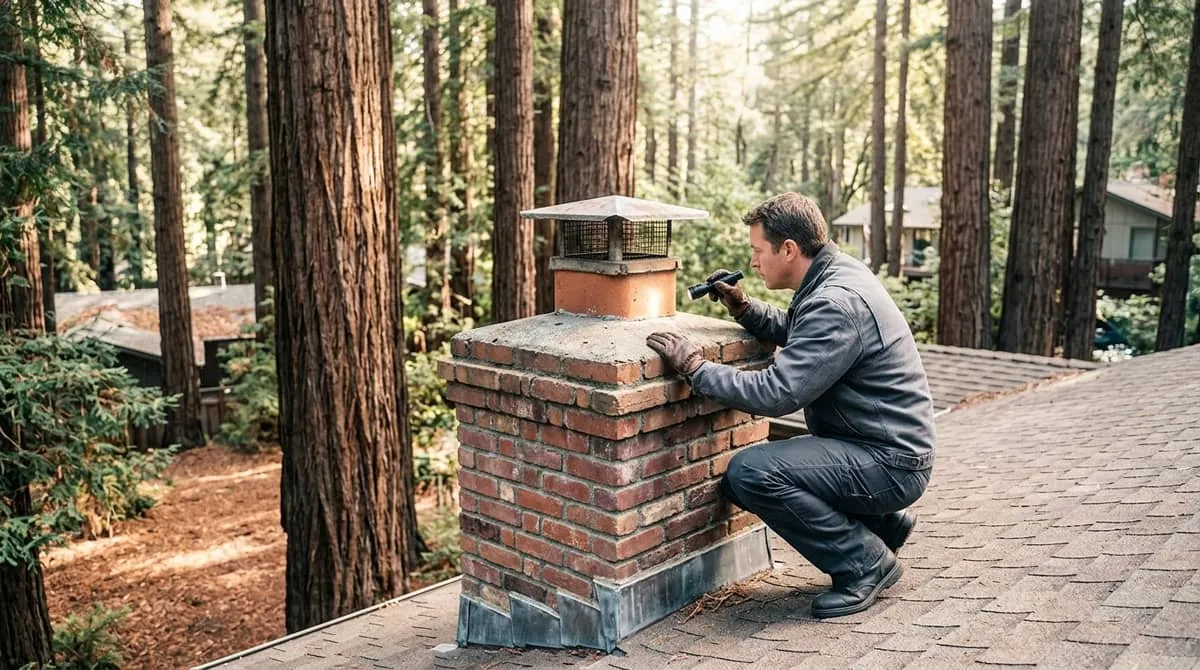
Chimney draft — the pull of air up the flue that carries smoke out instead of into the room — depends on a fairly simple physical principle: warm air rises, and a properly sized, unobstructed flue lets it rise efficiently. In most of the country, the local factors that complicate that principle are modest. In the shadow of Mount Tamalpais, they are not modest at all, and a mountain that dominates the skyline of Mill Valley, Fairfax and much of central Marin also dominates the local wind and fog patterns in a way that genuinely changes how a chimney draws.
Why terrain matters for draft in the first place
Draft is driven by the temperature and pressure difference between the air inside a heated flue and the air outside it, and wind at the top of the chimney affects that difference directly — a steady breeze across the flue opening generally helps draw smoke out, while a gusty, turbulent wind pattern can do the opposite, pushing air back down the flue in unpredictable puffs. Flat, open terrain tends to produce fairly steady, predictable wind at rooftop height. Mountainous terrain does not. Mount Tamalpais is tall enough and close enough to much of our service area to genuinely disturb the wind pattern at chimney height, particularly for homes built into its foothills and canyons.
Canyon streets get their own wind pattern entirely
Mill Valley’s older neighborhoods climb narrow redwood canyons — Cascade Canyon among them — where the terrain itself channels wind in a way an open street never would. Canyon wind tends to funnel and accelerate through the narrow gap, then swirl unpredictably where the canyon widens or a ridge interrupts it, and a chimney sitting at one of those transition points can see genuinely turbulent air at the flue opening even on a day that feels calm at ground level. That turbulence is a common, underappreciated cause of a fireplace that smokes intermittently rather than consistently — working fine on some evenings and pushing smoke back into the room on others, with no obvious change in how the fire itself was built.
Fog adds its own complication
Mount Tamalpais catches fog differently depending on elevation and which side of the mountain a property sits on — the western, ocean-facing slopes see it thicker and more often than the eastern side toward San Rafael, and elevation itself changes whether a given afternoon sits inside the fog layer or above it. Fog does not just add moisture; a fog-saturated air mass at the flue opening is denser and cooler than clear air, and that density difference can measurably reduce the natural draft a warm flue would otherwise produce, particularly right at the start of a fire before the flue has fully warmed. A fireplace that lights easily on a clear afternoon can genuinely struggle on a fog-bound evening a few days later, at the same address.
Elevation changes the baseline too
Homes built higher on Mount Tamalpais’ slopes — parts of Mill Valley and Fairfax climb a meaningful distance up the mountain — sit at a measurably different elevation than the baylands towns like Corte Madera or Larkspur, and air density decreases with elevation. That is a small effect on its own, but combined with canyon wind and fog exposure, it is one more variable in why a mountain-adjacent chimney does not behave like a textbook flatland example, and why a draft problem on one of these properties is worth diagnosing on-site rather than assuming a generic cause.
What actually helps, beyond the terrain itself
None of this means a mountain-adjacent chimney is destined to draft poorly — most work perfectly well, most of the time. What it means is that when a draft problem does show up, the terrain is worth considering alongside the more common causes: a flue liner sized wrong for the appliance, a chimney that is too short relative to the roofline or nearby trees, a damper not opening fully, or simply a cold flue that has not had a chance to warm before a fire is built up too quickly. A liner or damper issue is fixable outright. A terrain-driven turbulence pattern is not something we can change, but understanding that it is present changes how we advise a homeowner to build and tend a fire — sometimes as simply as a longer warm-up period before adding larger logs, to establish draft before the fire demands more of it.
When it is worth a proper inspection
A fireplace that smokes consistently, every time, regardless of weather, points toward a mechanical cause worth a real inspection — a liner problem, an obstruction, or a chimney genuinely too short for its surroundings. A fireplace that smokes intermittently, correlating loosely with wind or fog conditions, is more often a terrain effect worth understanding rather than a defect worth chasing. Telling the two apart is exactly what a cleaning and draft check accomplishes, since it rules out the mechanical causes directly rather than guessing from a description over the phone.
Booking a draft check in Mill Valley, Fairfax or elsewhere on the mountain
If a fireplace that used to draw well has started smoking unpredictably, tell us whether it seems to correlate with wind or fog, and we will check the mechanical causes first before pointing to terrain as the explanation. We work across a twenty-mile radius from central Sausalito, including the Mount Tamalpais foothill communities where this comes up most.
Read next
More from the blog
When chimney work in Marin County needs a permit
A chimney repair that needs a permit in San Rafael may route through a completely different office than the same repair in Fairfax or unincorporated Marin. Here is what typically triggers a permit, and who to ask.
Wildfire and WUI spark-arrestor rules in Marin County
Fairfax, Mill Valley’s canyon streets and parts of Novato sit inside a genuine Wildland-Urban Interface zone under California fire code. Here is what a WUI designation actually changes about a chimney cap, and how to tell if your property is inside one.
Chimney work on Sausalito’s hillside homes
A Sausalito hillside address is not a driveway job. Narrow switchback stairs, steep roof pitches and terraced lots change how equipment reaches the roof and how long a visit actually takes — here is what that means before you book.
Book a draft check
Tell us whether it correlates with wind or fog — we will check the mechanical causes first.