
Chimneys and flues in Sausalito’s floating-home community
A wood stove on a floating home is not bolted to a foundation the way a hillside house’s chimney is — it moves with the water underneath it. Here is what that genuinely different structure means for clearance, venting and inspection.
Published
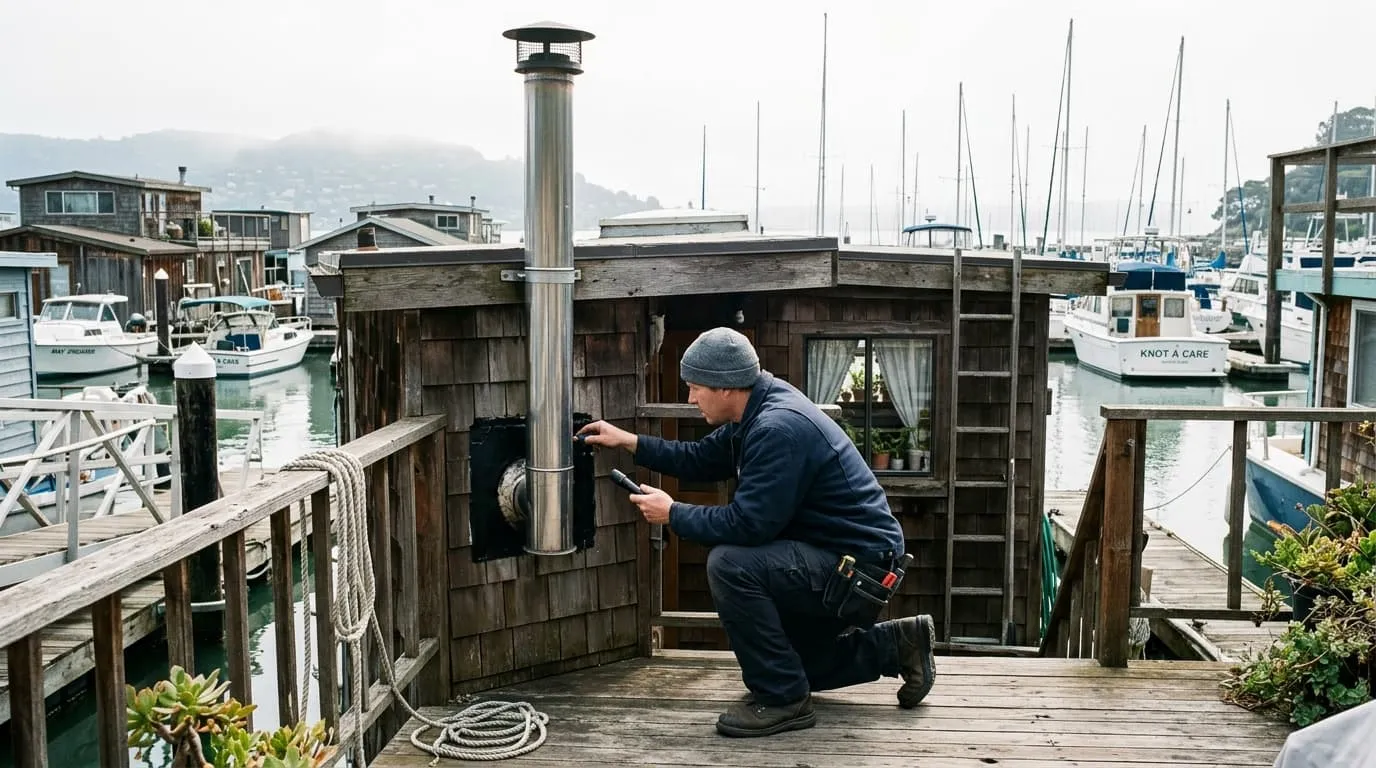
Sausalito is home to one of the largest floating-home communities on the West Coast, several hundred structures moored at Waldo Point Harbor and the docks around it. Many of those homes run a wood stove or a small fireplace insert for heat, and the venting question that comes with one is genuinely different from anything a hillside or waterfront house on solid ground has to think about — because the whole structure the flue passes through is floating on the bay, not sitting on a poured foundation.
Why a floating structure changes the venting question
A conventional chimney assumes a fixed relationship between the appliance, the flue and the roofline above it — the structure does not move, so the clearances and the pitch calculated once stay correct indefinitely. A floating home moves constantly, if subtly, with tide, wind and the wake of passing boats, and the flue passing through its roof has to accommodate that motion without the seals or the structural connections working loose over time. That is not a reason to avoid a wood stove on a floating home — plenty of Waldo Point Harbor residents run one safely for years — but it is a reason the connection points get checked on a genuinely different schedule than a fixed-foundation chimney would need.
Clearance rules do not relax for a smaller structure
Floating homes tend to run smaller than a comparable house on land, and it is a common and understandable instinct to assume a smaller structure means the clearance requirements around a wood stove can be reduced to match. They cannot. The manufacturer’s listed clearance-to-combustibles distance for a given stove model applies regardless of how much or how little space is available around it, because the physics of radiant heat from the stove body does not change based on the size of the room it sits in. On a floating home where interior space is already at a premium, that can mean a stove is positioned more carefully, or a smaller-clearance model is chosen specifically, rather than the clearance rule being treated as flexible.
Roof penetration is where a floating home differs most
On a conventional house, the seal where a flue passes through the roof is checked for weather-tightness and fire safety, and that is largely the whole story. On a floating home, that same penetration also has to tolerate the structure flexing slightly as it rides the water, which means the seal and the surrounding roof material need periodic re-checking in a way a fixed foundation’s equivalent joint does not. A seal that was correctly installed and watertight on day one can develop a small gap after enough seasons of that motion, well before it would show any comparable wear on solid ground — which is exactly the kind of thing a routine inspection catches before it becomes a leak.
What we check on a floating-home visit
A Waldo Point Harbor inspection covers the same fundamentals as any wood-burning appliance check — creosote buildup, liner condition, cap and spark-arrestor compliance — plus two things specific to a floating structure: the roof-penetration seal, checked for any sign of movement-related wear, and the stove’s clearance-to-combustibles distances, confirmed against the specific model installed rather than assumed from a general rule. We ask whether a home is a floating structure when the appointment is booked, precisely so the technician arrives already expecting to check both.
Spark-arrestor rules apply here too
California’s fire code and Marin County’s own Wildland-Urban Interface provisions do not carve out an exception for a floating structure — a wood stove flue on a houseboat needs the same compliant spark-arrestor mesh a hillside chimney does. Waldo Point Harbor’s proximity to open water reduces some wildfire concerns a hillside canyon property faces, but embers escaping a flue are still a fire-safety question on any structure, floating or not, and we fit the same code-compliant cap either way.
A community worth planning for properly, not avoiding
Nothing about a floating home makes a wood stove unsafe by nature — plenty of Waldo Point Harbor’s residents have run one for decades without incident. What it takes is treating the structure honestly for what it is, rather than applying a fixed-foundation checklist to it and hoping the differences do not matter. A technician who has never serviced a floating home before is exactly the kind of technician who might miss the roof-seal check that actually matters here.
Carbon monoxide detection matters more, not less
Every wood-burning appliance carries some carbon-monoxide risk if venting fails, and that risk does not shrink on a smaller floating structure — if anything, a compact interior with less air volume to dilute a leak makes reliable detection more important, not less. We recommend a working CO detector near any solid-fuel appliance on a floating home as a baseline precaution, checked and replaced on the schedule its manufacturer specifies, alongside the venting and seal checks we do during a service visit. This is standard advice for any wood-burning appliance, floating home or not, but it is worth restating plainly here because a compact living space raises the stakes if it is skipped.
How often a floating-home system actually needs checking
Because of the added wear a floating structure’s motion puts on the roof-penetration seal, we generally recommend a floating-home wood stove get looked at on a slightly shorter interval than the standard annual sweep-and-inspect cycle a fixed-foundation chimney follows — not because the stove itself burns differently, but because the seal and clearance points are the parts most likely to shift gradually in a way a fixed home’s equivalent joints simply do not experience. A resident who has had the same stove serviced on a floating home for years develops a sense of how often their specific structure needs a look; a newer Waldo Point Harbor resident is better served starting with the shorter interval until that pattern is established.
Booking a visit in Sausalito’s floating-home community
Tell us it is a floating home when you call, and we will bring the right approach from the start — checking the roof-penetration seal, confirming clearance against the specific stove model, and fitting a compliant cap, alongside the standard sweep or inspection work. We work across the whole of Sausalito, Waldo Point Harbor included, within our twenty-mile radius from the town center.
Read next
More from the blog
When chimney work in Marin County needs a permit
A chimney repair that needs a permit in San Rafael may route through a completely different office than the same repair in Fairfax or unincorporated Marin. Here is what typically triggers a permit, and who to ask.
Wildfire and WUI spark-arrestor rules in Marin County
Fairfax, Mill Valley’s canyon streets and parts of Novato sit inside a genuine Wildland-Urban Interface zone under California fire code. Here is what a WUI designation actually changes about a chimney cap, and how to tell if your property is inside one.
How Mount Tamalpais' terrain affects chimney draft
Two nearly identical fireplaces a few streets apart in Mill Valley or Fairfax can draw completely differently, and the reason usually has more to do with the mountain looming over both of them than with either chimney itself.
Book a floating-home inspection
Tell us it is a floating home when you call — we will bring the right approach from the start.