
Marine layer and salt air: what they do to a Sausalito chimney
Sausalito sits at sea level directly on the harbor, which means the marine layer and salt spray reach a chimney with none of the buffering distance an inland Marin town gets. Here is why fog-hours and salt exposure matter more than rainfall totals, and where to look first.
Published
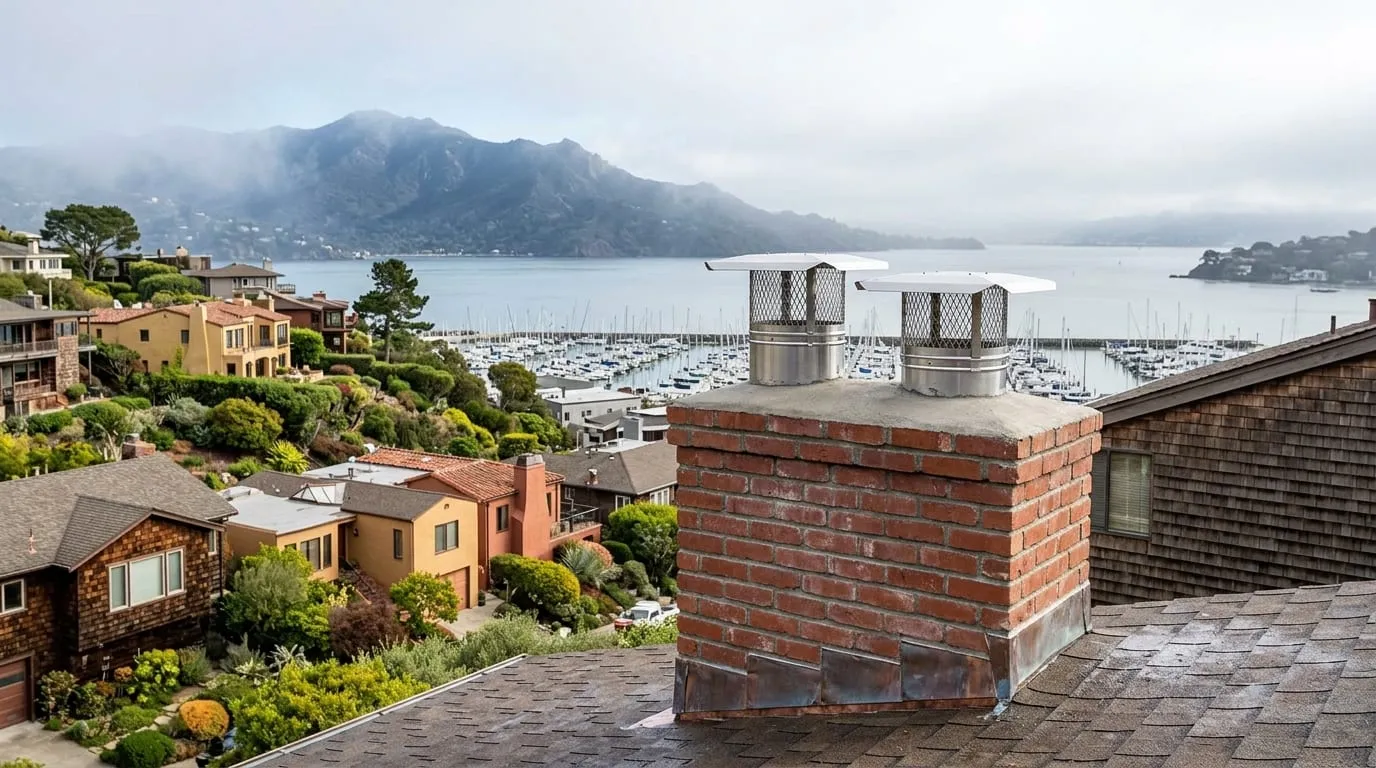
Picture what most people imagine damages something left outside in a wet region, and rain comes to mind — a soaking downpour followed by a dry spell that lets the surface recover. Sausalito’s chimneys rarely get that recovery window, far less often than the town’s unremarkable annual rainfall total would suggest, because rain is not actually what is working on them most of the year. The marine layer is, and a town sitting right at the water’s edge experiences a more direct, more relentless version of it than a hillside city set back from the harbor.
Fog behaves differently in a harbor town
Marine layer starts when warm air moving over cold Pacific water condenses, then gets funneled inland through the Golden Gate. It reaches Sausalito almost immediately — the town sits right on the water at the base of that very gap, with no real distance or elevation to thin the fog out before it arrives. Unlike rain, it never falls and drains away. It settles onto a surface and stays there, sometimes for the better part of a night and well into the next morning before finally lifting, if it lifts at all that day. A crown at harbor level ends up staying wet continuously for stretches far longer, and far more frequently across the year, than any rainfall chart would ever hint at.
What that means for how a crack develops
A crown exists to send water off the top of the stack and away from the brick underneath it. At first, a hairline crack there is purely cosmetic — too small to leak visibly, easy to write off. What turns it into a real problem is repeated contact with standing moisture: water sitting in that crack does two things at once, seeping gradually into the masonry underneath and, during any cold snap, freezing and expanding to pry the crack open a little wider each time. In a genuinely dry region, that same crack might stay more or less stable for years, with only the occasional storm giving it anything to work with. Sausalito’s marine-layer pattern hands it vastly more wet-hours across a year, so a crack that would take a long time to become serious somewhere else can worsen noticeably faster on a roof facing the harbor.
Salt adds a second front, and it hits Sausalito directly
Along with moisture, marine layer rolling off the Pacific and across the bay carries real dissolved salt, and the closer a property sits to open water, the more of it reaches that property — which in Sausalito describes most of the town. Along Bridgeway and the other waterfront stretches, homes sit at sea level right against the harbor with almost nothing buffering the chimney from salt-laden air. That salty moisture does measurably more damage to an exposed metal cap than plain fresh water would, speeding up corrosion on galvanized steel especially, pitting and weakening a cap that would otherwise hold up far longer somewhere inland like Novato or San Rafael. A cap on a Sausalito property that has taken a decade or more of direct harbor exposure can look perfectly fine from the ground while already thinning from the inside — part of why stainless steel or a heavier galvanized gauge gets favored specifically for waterfront addresses.
Hillside properties face a different version of the same problem
Sea level is not where every Sausalito chimney sits. Old Town climbs steeply above the harbor, and homes higher up that grade meet the marine layer as rising, cooling fog rather than as standing moisture pooling at water level. That exposure is no less real — if anything it can be more constant, since fog drifting up a hillside tends to hang against an exposed roofline — though the actual mechanism differs somewhat from the direct salt spray hitting a harborfront property. Whichever version of marine exposure a given address faces, the crown, the mortar and the cap remain the three spots checked first.
From a compromised crown, the path is the same everywhere
Once moisture from the marine layer gets past a crown that has failed, it follows the same route any other water intrusion would: down into the mortar joints — more porous than brick itself and built as the sacrificial material in traditional masonry — then potentially into the flashing where the chimney meets the roof, and in the worst cases all the way into the flue liner. That order — crown first, then mortar, then flashing, liner last — is exactly why a real inspection works through the whole sequence rather than treating whatever symptom happens to be visible from inside the house as the complete picture.
Getting ahead of it before a ceiling stain shows up
By the time a ceiling stain appears near the chimney, the underlying marine-layer moisture problem has already been progressing for a while — that is a late-stage sign, never an early one. A visible crack across the crown, discoloration on the brick face just below it, or mortar that has gone chalky or is visibly missing in spots are all worth acting on well before anything shows up inside the house, and on a harbor-level Sausalito property those signs deserve checking on a tighter cycle than a comparable inland home would need. A standard annual inspection, the kind already bundled into a sweep, tends to catch most of this back at the crown stage, while it is still a small fix.
What this means in practice
The marine layer here is not an occasional weather event — for a town sitting right at the mouth of the Golden Gate, it functions closer to a daily condition for much of the year, working on an exposed chimney regardless of whether the forecast mentions rain at all. Checking the crown, mortar and flashing with actual harbor-level exposure in mind, rather than a generic climate assumption, is worth doing on a shorter interval than a drier inland Marin town would ever need — and if it has been more than a year since all three got a close look together, that inspection is worth booking before the wet season fully arrives.
Read next
More from the blog
When chimney work in Marin County needs a permit
A chimney repair that needs a permit in San Rafael may route through a completely different office than the same repair in Fairfax or unincorporated Marin. Here is what typically triggers a permit, and who to ask.
Wildfire and WUI spark-arrestor rules in Marin County
Fairfax, Mill Valley’s canyon streets and parts of Novato sit inside a genuine Wildland-Urban Interface zone under California fire code. Here is what a WUI designation actually changes about a chimney cap, and how to tell if your property is inside one.
How Mount Tamalpais' terrain affects chimney draft
Two nearly identical fireplaces a few streets apart in Mill Valley or Fairfax can draw completely differently, and the reason usually has more to do with the mountain looming over both of them than with either chimney itself.
Get the crown and flashing checked
Describe what you have noticed — we will diagnose it and put the scope in writing.